Jason Hausman is an Emmy Award Winning composer, sound designer and songwriter, who has many projects (one of which with Marillion's guitarist, Steve Rothery), and who has composed countless songs for television shows and commercials, winning, among the other prizes, dozens of ADDY and TELLY Awards.
You can check out his work at his website
http://www.hotsake.tv
GuitarNerdingBlog: Hello Jason and welcome to Atoragon's Guitar Nerding Blog!
Introduce yourself to our readers, tell us your story!
JasonHausman: Well, I was born and raised in Terre Haute, Indiana. I started playing violin at age 10 and then switched to percussion at age 12. I was digging into drum kit fairly seriously early on. I found myself humming and singing along with the records I was playing to. It wasn't too long before I was singing and playing drums in bands. After high school I went to live with my father in North Carolina and ended up attending The University of North Carolina at Greensboro as a percussion performance major. I started playing guitar and fronting bands at that time. I eventually left UNC-G and started playing in rock bands as my main focus. I played a lot of gigs and put out a few CD's etc. It was a fun time and a hard time. But I would certainly do it all over again.
Fast forward 10 years and I found myself in a job interview with Jay Howard Production Audio in Charlotte, NC. I got a job answering phones for the studio. Within a few months I was engineering, which quickly led to my becoming Operations Manager. Within another year I was General Manager. After 5 years I made the decision that I wanted to open my own place, which would focus less on voiceover recording and more on custom music, scoring and sound design. I opened Hot Sakē in December of 2004. It's been a good ride, I certainly don't have any complaints.
GNB: Tell us about your career. By visiting your websites ( http://www.jasonhausman.com/ &http://www.hotsake.tv ) it appears that you've already had an interesting career, taking part in different projects, especially as a studio musician.
Which are the ones that you consider your career highlights? Which are the artists that influenced you the most? Is there still some collaboration that you'd wish to do?
JH: Having my music on a Super Bowl Ad for Carmax was awesome. The EMMY's are always a nice reminder that I am at least on the right track. Last year I won a National TELLY Award for Best Sound and Sound Design in a Documentary. The EMMY I won last year was for a PBS documentary. I brought in Steve Rothery (Marillion) on that project, as well as my main go-to for contract composing help, Dan Hood.
Steve and I had worked on some of my personal music together but Steve had not done anything for TV. It was really cool working with him and a new experience for me as well. Songwriting is a very personal thing to me, even as a commercial composer - I prefer to do it alone. It was a lot of fun with Steve though and he, of course, brought a lot to the table. I hope to bring him in on some more projects in the future.
I just finished a new single called Failure that features Dave Foster of Mr. So & So on lead guitar. Like Steve, he is just such a good dude and a great guitarist. He really put some incredible stuff on that track. The video was just shot and we should be releasing it with some b-sides in March. Dave and I plan to do some more work together this year.
I have another tune I plan to release soon that I wrote with Steve. Native Instruments Maschine endorser, Justin Aswell will be a part of that tune as well. Hoping to release it with a video in June.
Other dream collaborations? Trent Reznor, David Sylvian, David Torn for starters!
GNB: I've heard that you are a guitar lover and are about to receive two Jason Hausman signature model guitars and a signature amp! Tell us about your love for this instrument and about your favourite models, as well as your creations!
JH: I currently endorse four incredible companies: Jack Dent Guitars (Electrics), Oldfield Tube Amps, Coobs Guitars (Acoustics) and TheGigRig.
Jack Dent asked me a couple years ago if I would like to have a Jason Hausman Signature Model. We have been working on it for about two years. Jack is a true perfectionist and wanted this guitar to be something truly special. We are in the final stages of finishing up the first one. It is going to be a very cool guitar - mahogany neck and body, topped and backed in sculpted birdseye maple, ebony fret board and Lollar P90 neck pickup and mini-humbucker bridge pickup. I am honored to be a part of the JDG family which includes Steve Rothery and Steve Hackett.
Paul Gussler of Oldfield Tube Amps has been a good friend and big supporter of what I do for a long time. I currently have two of his amps: a Hot Sakē Edition Marquis 30 combo that has both a 10" and 12" speaker (Blue Pup and Blue Dog) and a Marquis 15 head with a single 12" cabinet. They are truly amazing amps. Steve Rothery ordered a Marquis 15 immediately after playing mine. Other artists include Bon Lozaga and Bob Weir.
I just signed on with Coobs Guitars and Mr Coobs is currently building a Jason Hausman Acoustic Model. I am really looking forward to this guitar. It is a close design of an old acoustic that my mother found at a yard sale in the early '70's for $25. A slightly modified 000 body style. I've had this guitar most of my life and there is something about it that is magical, but it has seen better days. I am excited to have something more dependable and well. built as only Coobs can build it!
Through my friendship with Rothery I discovered the UK company called TheGigRig. I have an artist deal with them. Their switching systems keep my insane pedal boards under control with simplicity and elegance. Just love their stuff!
GNB: What do you think about the state of the music business? What are your thoughts about today's underground and mainstream music scene?
JH: I am honestly really excited about what has been happening with the music industry. The doors have been kicked in. It's just awesome! With YouTube, Vimeo, SoundCloud, Facebook as well as the power of current computers and DAWS, the sky is the limit for upcoming artists. The difficulty is finding the good stuff. It rises to the top eventually though. I think it kind of finds you. With artists like Radiohead and Sigur Ros still cranking out brilliant works, and new artists like James Blake and Fink, it is a really exciting time.
I love a great pop song as much as the next guy, but I tend gravitate towards those coloring outside the lines. always have.
GNB: What do you think about the digital music distribution? And what about the file sharing? How do you think the music business will evolve in the future?
I love that it destroyed the big labels stranglehold on the industry. I hate that is making it more and more difficult to be a working artist. Marillion have made it their business to work the new system to their benefit and I am blown away by the loyalty and willingness of their fan base to fork out money consistently for that band. They were arguably the first band to bust away from the major label system and make the Internet their label. Now it seems to be the norm. Steve Rothery just received 4 times the $15,000 euro asked for on KickStarter the other day! That is fan support!!
We are seeing artists placing songs in film, commercials etc. these days in order to not only get exposure but also to make money. It's tuff out there with the file-sharing going on. That said, every time it's shared it's a potential new fan. What I am seeing though, is that with the immediate accessibility to recorded music, fans are starting to crave live music again. They are also starting to wake up, finally, to the horrible audio format called the MP3! I am seeing more and more people with vinyl and turn tables at home. It is exciting to see.
GNB: Let's talk about live music! Which have been the best gigs you have ever played? Do you consider yourself more a live musician or a studio one?
I consider myself to be both. I built my career on gigging. So playing live is something that I crave. Since starting Hot Sakē, gigging has had to take a back seat to my scoring and sound design career. I love torturing sound in the studio and thinking outside the box, so Hot Sakē is truly my favorite playground. I just have to get out and perform live every once in awhile to wake that other part of my soul back up. I have shared the stage with some incredible artists over the years. I have also been smart enough to surround myself with musicians that are MUCH better than I am. This achieves two things, makes me look better and also stretches me as a musician.
I've shared stages with Fuel, Herbie Mann, Larry Coryell, Ben Folds Five and so many others. Some of my favorite shows have been with Sunshone Still and my old trio godmanradio. So many great moments, I just love performing live. I like pouring myself out into the universe.
Speaking to that, the memorial show for band mate Rodney Lanier at The Chop Shop in Charlotte, NC. We only played a couple songs, but I felt him flowing through me, the gear, the air and everyone in the packed room. It was magical. It was like one of those dreams where you are on stage and you can play things in a way you never thought you could. I felt connected to everything in a way that seldom happens in a lifetime of looking for that conduit.
So, to that I say it is the friendships made through the bond of music. It's what is most important to me. My circle, and especially the boys of Sunshone Still, lost a dear friend and incredible musician in Rodney right after we finished the latest Sunshone Still Record. It really drove home how deep the music bonds us together.
GNB: Tell us some funny story: which one has been your best/funniest experience as a musician?
JH: Funny is having a gig at a bar in Eveleth Minnesota during the High School National Hockey Championships. Having the entire club turned away from the band watching hockey on the TV while the owner of the club is coming up to us every 5 minutes telling us to turn down to the point where we were so quiet it sounded like we were playing through an iPhone with ear-buds! When we asked if we could just stop playing he said "F*&k no! (insert Fargo Accent) I am paying you to play! So play, just be f*&king quiet!" Ahhh, such is life on the road.
And your worst one?
This is something I have only told a couple of people, but it changed the course of my stage life. When I was a young drummer in middle school I was asked to perform a snare drum solo moment in my hometown. This was to be all the school bands in the city performing several pieces in the civic center for a huge crowd. It was a really big deal to be asked to play this solo. At first, I thought I was the only one to be performing the drum solo and I was totally fine with it. When I found out that a drummer from another school was to perform it with me, I was suddenly extremely nervous. I practiced constantly and felt like I was ready. At the dress rehearsal I choked and the other drummer nailed it. I went home that night and instead of bucking up and getting my act together I devised a plan.
The day of the concert I told my mom I was sick and stayed home and hid in my bed. That is the one that stuck with me to this day and will for the rest of my life. I have blown songs, flubbed parts, forgotten words and made an ass of myself on stage. But since that one moment of complete and utter defeat I have lived my life turning that failure into energy. I just get up there and do the best I can and pour everything I have got into everything I do. Still making up for it I guess. Making up for the regret of that moment. I've never had stage fright since.
GNB: Since many readers of our blog are interested mainly in the technical side of the guitar world, can you tell us your studio and live equipment?
JH: My current live rig is a relatively long list.
Jack Dent Hot Sakē Edition Tele Thinline with bigsby, Fralin P-90's and a kill button. This JDG will soon be joined by my new signature model described above.
Fender Telecaster (American Standard - Ash Body/Maple Neck) with Fralin single coils, and a kill button, 60 cycle hum button and a "microphone on" button (mic taped to pickguard).
Oldfield M15 head with oversized 1x12 cab with ToneTubby Green
Trailer Trash pedal board with TheGigRig custom built Quartermaster10
Pedals: zVex Super Hard On, Ernie Ball Volume, Sonic Research Strobe Tuner, Old ProCo Rat, Older Fulltone Fulldrive2, Cochran Timmy Overdrive, Fulltone Supa-Trem, EH Pog2, Empress Superdelay, modified Boss DD-5, Malekko Phase, Strymon BlueSky Reverb, Korg KAOSS Pad Quad and Boomerang 3. My favorites being the Timmy and the Strymon BlueSky.
I also use, eBow, Cello Bow, BleepLabs Thingamagoop2 (into my pickups), springs, alligator clips, pencils, voice through pickups etc. My thumb ring is actually one of my go-to sound devices on guitar.
Studio includes all of that and a Tascam field recorder so I have an entire world of instruments just outside the studio door. Lots of guitars, a bass, gretsch drum kit etc. I use Apple Computers, Logic Pro X, and tons of software instruments and plugins. It's all about efficiency and speed in my business. When it hits you, you can't waste time plugging up a bunch of outboard gear. You gotta start putting it down while the iron is hot. To be honest I have just a few cheap mics and a couple cheap mic preamps. I can't live without my Blue Baby Bottle mic (most expensive mic I have at $399 - which is cheap!), my contact mics, my $5 ebay pill bottle mic and my pair of Oktava MK-012's. Oh, and my closet of sound making toys!!!
GNB: Can you tell us about the recordings of your latest album?
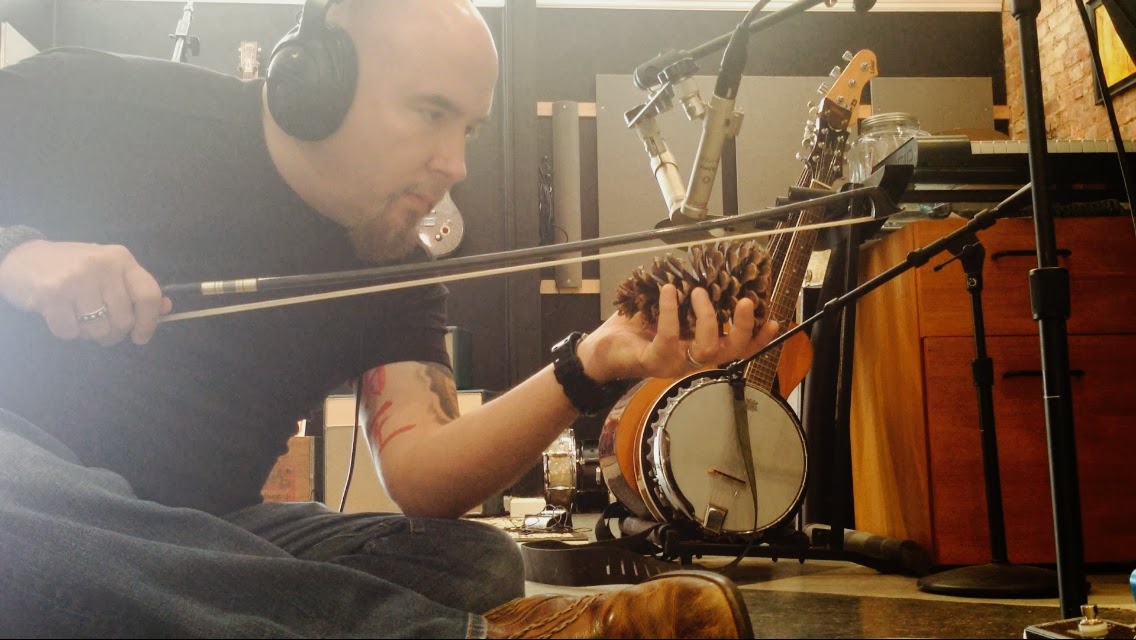
JH: I am bringing a lot of my experience as a sound designer into the process to my new music. The songs have tortured animal sounds (a la Talk Talk), drums made from beads, pinecones, my voice and anything I can hit. There are abstract ambient pieces, classical pieces as well as more traditional rock tracks. I have decided to release a series of singles with b-sides (EP's) throughout the year. A couple of videos and a lot of music.
Beyond the collaborations with Steve Rothery and Dave Foster, Matt Postle and Radek Rudnicki of RPE Duo, Justin Aswell of Mr Invisible and Bon Lozaga of Gong/Gongzilla will also be making appearances. Everything else on the songs are performed by me at Hot Sakē. Rothery is graciously playing on several tracks. He is simply put, a brilliant lyrical guitarist and a damn good guy.
GNB: Is there any advice that you'd like to tell to our fellow guitar players?
JH: Play for the love of it. Think outside the box. Pour it out of you no matter what it is that churns inside. Don't wait for anyone else to make your career cause it's on you. Oh, and most importantly, be nice.
GNB: I know that you love to produce music with sounds of objects, such as office equipment, or with sounds taken from the nature. Tell us something about this unusual interest!
JH: It's nothing new. Foley artists have been doing it for decades, as have bands like Pink Floyd, The Beatles and Talk Talk. It's just something I gravitate to. I find all these great sounds banging on some pipe on city streets or a hollow log in the woods. Three of my favorite bass drum sounds that I have ever stumbled upon: old TV set, nylon webbing on a baby stroller and a scale of a pinecone. It really came about from the sound design we create at Hot Sakē. We don't like to use sound libraries. We prefer to make the sounds from scratch. If we DO use a library sound it might be an animal growl that we then torture and turn into a part of a transition swoosh or a car engine. One of the tracks Dave Foster and I are finishing up from the new record has my voice as most of the drums run through a myriad of FX and then re-amped through a guitar amp. It's a HUGE drum sound. I just get lost in the process of making sounds. It's so Zen.
GNB: The interview is over! Tell us about your latest album and projects! Thank you very much and we hope to see you soon live!
JH: We finished doing shows for the last Sunshone Still record and I am hoping Chris Smith will be bringing the band the sketches for the next record. I love playing guitar, noise and doing album arrangements for that project. It's the first time I have not been the lead vocalist in a band and it really stretches me as a guitarist. I am not at all a conventional guitarist. sort of the anti-guitarist, I look at it as just another tool to make noises with.
I am finishing the first of many EP's for this year. Currently working on a Neo-Soul Hip-Hop project called The Bodacious Wicked with the incredible Dre Rock. I plan to do some writing with Justin Aswell, Dave Foster and musician/producer Patrick Boyd. I am hoping to write some tunes with the boys from RPE Duo as well (hint-hint boys!). They are just brilliant! We will see what the future brings!
At Hot Sakē it's been projects for Britax, Husqvarna, Brica, Volvo Trucks, PBS to name a few. I am just starting the score for a short film call "Like Rats In A Trap". I guess I am kind of all over the place! I wouldn't have it any other way!